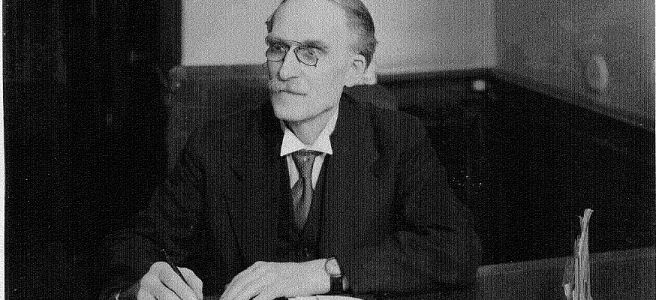
By Dr. Martin Littlejohn (1865–1947)
(This was originally printed in The National Message in March of 1923.)
A little about the Author and Note from the Editor:
John Martin Littlejohn was a Scottish-born Reformed Presbyterian minister, scholar, educator, and pioneer of osteopathy. He attended the University of Glasgow, where he earned degrees in Arts, Divinity, and Law. He was ordained in 1886 and taught theology the following winter. After moving to the United States in 1892, Littlejohn held academic posts, including the presidency of Amity College in Iowa. In 1897 he sought treatment from osteopathy founder Andrew Taylor Still, then studied and taught osteopathy. He later helped establish an osteopathic college in Chicago with his brothers. Returning to Britain, he founded the British School of Osteopathy in London in 1917.
The author of this article believed the modern-day Jews were from the tribe of Judah, and thus represented Judah in Bible prophecy. This idea was incorrect. Although modern Jews may have some percentage of Judahite heritage stemming back to the time of the Pharisees, they are mainly made up of Edomite and Canaanite peoples. This idea of them being Judah was corrected in later writings from Anglo-Israel believers.
—
Mr. President, ladies and gentlemen:
I have a personal interest in British-Israel. I was born among the Scottish Covenanters, who believe in the Psalmody of the Bible as that of the universal Church, in which the Israel truth is expressed. Their main doctrine, emblazoned on the banners they bore on battlefields in defense of civil and religious liberty, is the universal mediatorial dominion of the Lord Jesus Christ as King of kings and Lord of lords—the Lord of the nations and kingdoms of the world.
My father was, by direct descent, a Benjamite of Huguenot stock. Wilson of Kilmarnock was one of my direct ancestors on my mother’s side. British-Israel truth has always fascinated me, and I believed it from boyhood.
What I like most about British-Israel truth is that it explains the foundations of historical truth and carries forward the continuity of thought, purpose, and development in connection with the human family and God’s history of humanity in the Bible story. It takes account of the different migrations, settlements, and ethnic relationships that lie at the foundation of the British people. It explains, I believe, why Britain alone is the most worldwide empire and English the most universal language of national life.
Of all empires, the British Empire stands out as the most universal in extent and influence. Centered in these Isles of the Northwest, it has spread its influence throughout the world. In population, position, and influence among the peoples of the world, it stands alone. Our British Empire extends over seventy colonial dominions, is fifty-two times the size of France or Germany, and three times the size of all Europe.
During the Great War, we were told of Germany’s great and overpowering influence in the United States. The last U.S. census showed that, of its 105 million people, 55 million were either British-born or of British descent—a greater Britain in the great Republic of the West. During the last forty years, the populations of Great Britain and the United States have doubled, surely entitling them to be called a great and multitudinous people.
The Bible and the History of Redemption
Dr. Koenig, writing in The Expositor on “the burning problem of the hour in Old Testament religion,” says the most important question is whether the history of Old Testament religion began with the call of Abraham. He identifies three alternative views:
- Some deny that the true religion of the Old Testament goes back to Moses.
- Some regard the patriarchs as never having existed.
- Others regard the patriarchs, if they ever existed, as possessing only a low type of religion.
Koenig proves, as he sees it, that the theory of the polytheistic character of Israel’s early religion is unfounded. Abraham separated himself from his kindred on religious grounds, and in doing so marked a new starting point for human religion—in fact, its beginning. Koenig writes:
“These recent methods of research in the study of Israel’s religious history are allied in the last resort with the general tendency of modern historical investigation inspired by Darwin. According to this theory the development must have advanced from a lower to a higher stage, and even in the true religion of Israel no gleam of light may be discovered from the world beyond this earth.… The burning problem of the hour in Old Testament religion will find its solution when the Biblical account of the Call of Abraham, as the beginning of the history of redemption in Holy Scripture, is accepted as an authentic narrative.”
This question raises the larger issue of the genuineness, authenticity, and integrity of the Bible as the Old and New Testament Scriptures.
In modern times, the events and developments of history move quickly and lead toward a climax, when all past events will receive their summation in the final consummation: the unveiling of God in the Person of the world’s Redeemer, the universal Sovereign of the universe; and the enthronement and ennoblement of man, as all things in heaven and earth are gathered together under the dominion of man, both redeemed and saved, as God’s sovereign in the world.
To lead toward this ideal, God has appointed and uses the means He Himself predestinated. All the leading highways of His providence point toward the same goal: the restoration of God’s authority and the establishment of humanity’s chartered and vested rights against the powers of evil, the claims of the prince of darkness, and the effects of sin.
God has ever been seeking after man. His greatest work was man’s creation, his investiture with the heavenly image, and his enthronement over all other creations as God’s universal governor—His vicegerent, gathering up the world’s tribute of reverence, homage, and allegiance to present to the great universal Father.
The chain of events in human and world history has been welded in the divine purposes and lengthened across the vistas of time by the providential hand. Its links are formed of the people God Himself has selected from the human family: Adam, Noah, Abraham, David, Jesus Christ, and the Christ-men and women of historical times.
The Need for a Historical Faith
When one reads reports of a Church Congress, like the one held at Sheffield, one wonders whether the Church that professes devotion to Jesus Christ is the true custodian of the Bible and the faithful defender of the Word of God.
The other morning, I asked two laymen on a train why they did not belong to the Church of Christ. They gave the same answer: “The inconsistencies of the clergy and their scatter-brained policy of looking at the Bible as something to pick to pieces.”
If the story of Abraham and the miracle of Jonah are myths, and the doctrine of Paul’s conversion is a dream of hysterical enthusiasts, then we must search more deeply for a solid foundation on which to build the faith and hope of the world’s select ones.
I say “select” because, as a Calvinist, while I bow in respectful reverence before the genius of Calvin, I believe he introduced confusion into Calvinistic theology by using elect instead of select—select being the divine plan.
British-Israel Truth and the Identity of Israel
British-Israel furnishes the answer. The identity truth proclaims one God through all the dispensations of the world’s history; one purpose running through all the changes of time, migrations, and intermingling of peoples; and an identity in “the one far-off Divine event to which the whole creation moves.” This concerns not only creatures but all creation, “for the whole creation groaneth and travaileth in pain together until now,” awaiting the redemption of the children of God.
“God, Who at sundry times and in divers manners spake in time past unto the fathers by the prophets, hath in these last days spoken unto us by His Son, Whom He hath appointed heir of all things, by Whom also He made the worlds.”
The identity truth means the identification of Britain with Israel as the people—the covenant people, the Lo-Ammi of Jehovah, to be gathered in as the Ammi. It is a long distance from the land of Palestine and the promise Jehovah gave to Abraham and his seed. A long stretch of history lies between then and now, but, I believe, every step can be traced under divine leadership. In the sands of time, we can clearly trace God’s footsteps.
I have been asked, “What are the foundations on which British-Israel truth rests?” There are four basic foundations on which it rests. Even though I repeat what others have said, I do so to emphasize our beliefs.
1. The unity, integrity, and authenticity of the Bible
The Bible is God’s revelation of Himself, of man, of the history and destiny of the world, and of divine providence. As I read the Bible, I interpret it as God in history: God’s hand in the records of mankind, God’s presence in all that He has made and done.
I believe that when God spoke, He meant exactly what He said. He did not speak in allegories or parables unless He said so. The Song of Songs is a beautiful allegory, the most entrancing in our literature. But Genesis, Exodus, Leviticus, Numbers, and the other historical books are records of history—word-pictures, written under the inspiration of the Spirit of God, concerning God’s people. Isaiah, too, represents God’s analysis of present and future history: the prophetic Word of God.
The story of the Garden of Eden, Noah’s Ark, the promises to the patriarchal fathers, and the later prophetic pictures of Israel’s future are genuine records of real historical and prophetic facts.
When, as a student of Isaiah, I listened to the original lectures of Dr. George Adam Smith, I often questioned the application of these prophetic pictures to the Church of Christ. When God spoke of Israel and of the Jews, He meant both Israel and the Jews, because Israel was His covenant people, the seed of Abraham, the father of the faithful.
There are three great phases, or epochs, in the revelation of the Bible:
(a) The Adamic covenant of Eden and post-Edenic revelation, in which God presented to man, through the first Adam, the charter of human life, liberty, and property as well as of labor; this charter is presented to us in the beautiful language of the eighth Psalm. The Adamic covenant was amplified and reiterated in the covenant of Noah, following the destruction of the human family by the Flood, when God renewed His covenant with mankind and his posterity, with the pledge of the rainbow in the heavens as the guarantee of perpetuity for the covenant with man , re-establishing man’s original charter, rights of life, liberty, property, dominion, and the pursuit of happiness in God’s service.
(b) The Abrahamic covenant. God had promised that the seed of the first woman, spoken of in the Adamic covenant, would redeem man from the consequences of sin. Because sin and corruption prevailed on the earth, God selected and ordained a chosen seed, calling that seed His own chosen and peculiar people. To them He gave promises and a promised land as a material guarantee of their fulfillment.
The Abrahamic covenant is elaborated in the promises to the patriarchal fathers, in the statutes, ordinances, constitution, and laws of the Mosaic dispensation, and in Paul’s discussions in Romans, Galatians, and Hebrews.
Jesus recognized this covenant when He chided the Jews: “If ye were Abraham’s seed.” Instead, He found otherwise and declared, “Ye are of your father the devil.” The type of faith He recognized, when He saw its saintliest example, was “an Israelite indeed, in whom is no guile.”
(c) Jesus Christ and the covenants. The last epoch in the history of God’s revelation is that of Jesus and Christ’s relation to both the Adamic and Abrahamic covenants.
The second chapter of Hebrews interprets Christ’s relation to the Adamic covenant. There Paul gives his interpretation and commentary on the eighth Psalm:
“Now we see not yet all things put under him [man]”—that is, we do not yet see the fulfillment of the Adamic covenant—“but we see Jesus, Who [for a little while] was made a little lower than the angels [in service] for the suffering of death, crowned with glory and honour, that He by the grace of God [salvation] should taste death for every man [Adam’s seed].”
Jesus, then, is the climax, representative, and fulfillment in Himself, as God’s selected one, of all the aspects of the Adamic covenant. He is the pledge and reinforcement of all the chartered rights of man in his birthright of creation.
Paul elsewhere interprets Christ’s relation to the Abrahamic covenant in Romans, Galatians, Hebrews, and Corinthians. He shows that, although the Adamic covenant had failed through rebellion and sin, God made good to man, by the grace of selection, all the rights and liberties of manhood: first to His chosen One, then to His chosen people, and through them to the rest of mankind.
Christ is presented as the seed and Son of the promise, the head of the great economy of freedom, and the selected representative of the dispensation of liberty. The whole family in heaven and earth is named after Jesus, who, as the Son of the woman, is Head over all things for the sake of His Church. The Church is the collective body of Christ, of which all are members and share in His Kingship. Here the climax is headship over a nation and people for the sake of His Church, in the dispensation of the fulfilled times, when all things are gathered together in one.
2. The Distinction Between Israel and Judah
A clear and definite distinction is drawn between Israel and Judah, the Israelites and the Jews. Today, people speak of the Jews and of Zionism as if only the Jews were interested in the promised land and God’s promises. Let us remember that the Jews are Judeans only.
Why did God preserve them? Because, during the dispersion and captivities, Israel’s identity would be lost; it was therefore necessary to preserve Judah’s identity in order to fulfill the promise:
“The sceptre shall not depart from Judah, nor a lawgiver from between his feet, until Shiloh come.”
They were preserved to preserve and guarantee the genealogy of Jesus Christ, who was to become the Saviour of the world. But when He was born of the House of David, He was to be greater than His father David and more glorious than Solomon. The ingathering of the people—God’s chosen—is the conclusion of the ancient promise. Who were the people? God’s chosen people: not Judah, but Israel.
Thus, in the line of development, we have Adam and Adam’s posterity in connection with the first covenant; Abraham and Abraham’s seed in connection with the second covenant; and, as the great head of the ultimate fulfillment, the Son of Man, by whom, to whom, and through whom the ingathering of the people was to take place.
Let us remember that the Saviour was to gather His people not only as individuals and subjects of salvation, but also as a nation redeemed from rebellion, sin, dispersion, and oblivion. “Blessed is that nation whose God is Jehovah.”
In the final vision of Patmos, among the multitude of the ransomed, not only Judah but the twelve tribes of Israel are represented by the 144,000, as well as by the great multitude no man can number, drawn from all peoples, kindreds, and tongues.
Speaking of their future glory, Christ declared to the Apostles:
“I appoint unto you a Kingdom, as My Father hath appointed unto Me, that ye may eat and drink at My table in My Kingdom, and sit on thrones judging the twelve tribes of Israel” (Luke 22:29).
3. The Historical Development of God’s Providence
The third foundation is the great historical development of God’s providence. This providential guidance and supervision was promised to the seed of Adam and Abraham. Through the progressive development of world history, God fulfilled this promise:
“Under the shadow of the wings of the Almighty”; “around and underneath the everlasting arms”; “the shadow of a great rock in a weary land”; “He that keepeth Israel shall neither slumber nor sleep.”
Here we have the history of the migration through the wilderness; settlement and residence in the promised land; the captivities and dispersion of Israel; and the migrations of Israelites from the time of the captivity to the present.
Monuments, tombstones, broken fragments of stone letters, and the names of cities, rivers, and countries all mark the stepping-stones of Israel’s progress across continents, over seas, and through valleys, toward the island home. There, transplanted from the plains of Media and the shores of the Caspian Sea to the center of the Western Empire, Israel found her resting place.
God dispersed the Israelites because they were to be scattered among the nations as Jehovah’s missionaries, lifting up the standard of God, God’s law, freedom, and God’s Sabbath in preparation for the Second Advent. The Sabbath was to be a perpetual sign of God’s people—not the Sabbath rest of creation, nor the Sabbath anniversary of deliverance from Egypt, but the Sabbath of resurrection memory until the King Himself returns to restore God’s Sabbath.
God established certain signs and institutions to unify all people. This was to take place through the observance of these institutions by God’s people. There are three great divine institutions:
(a) The Bible as God’s Word. The Old Testament contains the law, the prophets, and the Psalms. The New Testament is a series of interpretations of Jesus’ birth, life, death, and resurrection read into the Old Testament revelation. As such, “God’s law is perfect, converting the soul.”
(b) The Sabbath. The Sabbath of creation was God’s rest day, His seventh day of creation, but man’s first complete day, following the morning and evening of the day on which he was created. Although it was God’s rest day, Christ said, “My Father worketh hitherto, and I work.” It was as if He had said that God the Father had never rested.
Paul explains this when he tells us that God the Father used the agency of Jesus Christ in creation: “By Him were all things created, that are in heaven, and that are in earth.… All things were created by Him and for Him” (Colossians 1:16).
In his Epistle to the Hebrews, Paul presents these Hebrew institutions. Of the Sabbath he writes, “There remaineth”—or, “is left over”—“a keeping of Sabbath for the people of God.” The Sabbath is not, and never will be, exhausted. Its complete realization awaits the return of the King to His own people, “for the Sabbath is made for man, not man for the Sabbath.”
(c) Jesus Christ. The last institution given to God’s people is Jesus Christ, the Shiloh and Messiah of the Old Testament: “They drank of that rock which followed them, and that rock was Christ.” He is Jesus of Nazareth of the New Testament.
Much has been written about the New Testament dispensation. It is a succession of interpretive revelations of Jesus Christ to different peoples concerning God: “He that hath seen Me hath seen My Father.” Some speak as if the Sermon on the Mount were the entire Gospel. Peter puts the whole Gospel in these words: “To whom can we go? Thou [Christ] hast the words of eternal life.” And Christ said, “This is life eternal, that they might know Thee, the only true God, and Jesus Christ Whom Thou hast sent.”
The peoples of the world are to be unified in Jesus Christ. His person is the bond of union, and personal loyalty to Him is the test of discipleship. The climax of the covenants is Jesus Christ crowned as King of Kings and Lord of Lords.
As we study the history of Israel’s dispersion, wanderings, settlements, and organizations, and the character of our own ancestors in primitive times, we find there the essential character of God and of divine law. At the dawn of the Christian era, immediately after the Crucifixion of Christ, the missionaries of the Cross established the Gospel among the Britons. Long before the age of Augustine and the arrival of Roman Christianity on these shores, a native form of Christianity flourished in the Isles of the Sea—in North and South Britain and in Erin—and, the speaker argues, long predated Roman Catholicism.
God thus preserved these Isles for the Cross and for the banner of Israel: Jehovah Nissi.
4. The Rise and Development of the British Empire
The last foundation of British-Israel truth is found in the rise, progress, and development of the British Empire. Here, we find the original people in Great Britain with a form of worship analogous to the original Mosaic code.
Not long ago, Missionary Roscoe found a tribe in East Africa that had preserved the customs, laws, and usages—even the sanitary code—of the Mosaic institutions. Why not in Britain?
Soon after Christ’s Resurrection, we have, the speaker maintains, credible evidence of the establishment of the British Church. Anyone who has studied the primitive history of Great Britain can see, he argues, that the religion, laws, and customs native to our race are evident in this origin.
Why was Roman law acceptable to us as Britons when we rejected Roman Christianity? Why were the jus civile and the jus gentium of Rome received in these Isles? They are the only fragments of Roman civilization assimilated into British culture. The reason, the speaker says, is that Roman law represents the only relic of the Roman age of the Christian era that was truly Christian. It bore the mark of Christ, for, as published by the Emperor Justinian, it was set forth “in the name of Jesus.”
Read the history of Britain in the light of God’s promises to Israel, and ask whether any other nation that has ever existed fulfills these conditions as Great Britain does. Moses tells us:
“When the Most High divided to the nations their inheritance, when He separated the sons of Adam, He set the bounds of the people according to the number of the children of Israel [man ruling with God]; for the Lord’s portion is His people” (Deuteronomy 32:8–9).
We believe that the climax of nationhood in these last ages of the world represents a national fabric built on the principle of the Bible: “Righteousness exalteth a nation; sin is the curse of any people.”
Stretching out her arms in her imperial destiny over land and ocean, Britain gathers within her embrace peoples from every continent. She holds the gates of the earth so that, with an all-comprehensive influence, she casts the golden mantle of the Divine Being, divine law, and divine institutions as a golden chain around the earth, awaiting the unifying presence of the Master Israelite Himself—man ruling in and with God in the Person of the Lord Jesus Christ.
“Star unto star speaks light,
World unto world proclaims,
The password of the universe—
THE NAME OF CHRIST.”

